Every used EV buyer asks the same question: "what's the battery like?" Answer it with an independent, TÜV & CARA-certified battery report, the same evidence standard 750+ dealerships and 550,000+ tests worldwide already trust. Cars on your forecourt sell 36% faster, at a £700+ premium, with the same compliance footing the big franchise groups use to defend FOS complaints. Eligible EVs now carry a £2,700 warranty at no extra cost.
Every used EV buyer asks the same first question. The dealers who can answer it confidently, with independent, manufacturer-blind evidence, convert faster and command a premium. Same compliance footing as the franchise networks, none of the FOS exposure.
An AVILOO certificate puts a documented, third-party-verified answer in their hand at the point of sale, the same evidence standard the manufacturer-backed dealers rely on, without needing a franchise badge over the door.
Certified EVs move significantly faster off the forecourt. Removing the battery uncertainty removes the biggest single objection in the used EV market, buyers don't hesitate when the evidence is in their hand.
Certified used EVs command a measurable price premium over uncertified equivalents. The buyer knows what they're getting. You're not the dealer down the road trying to discount your way to a sale, you're the one with the evidence.
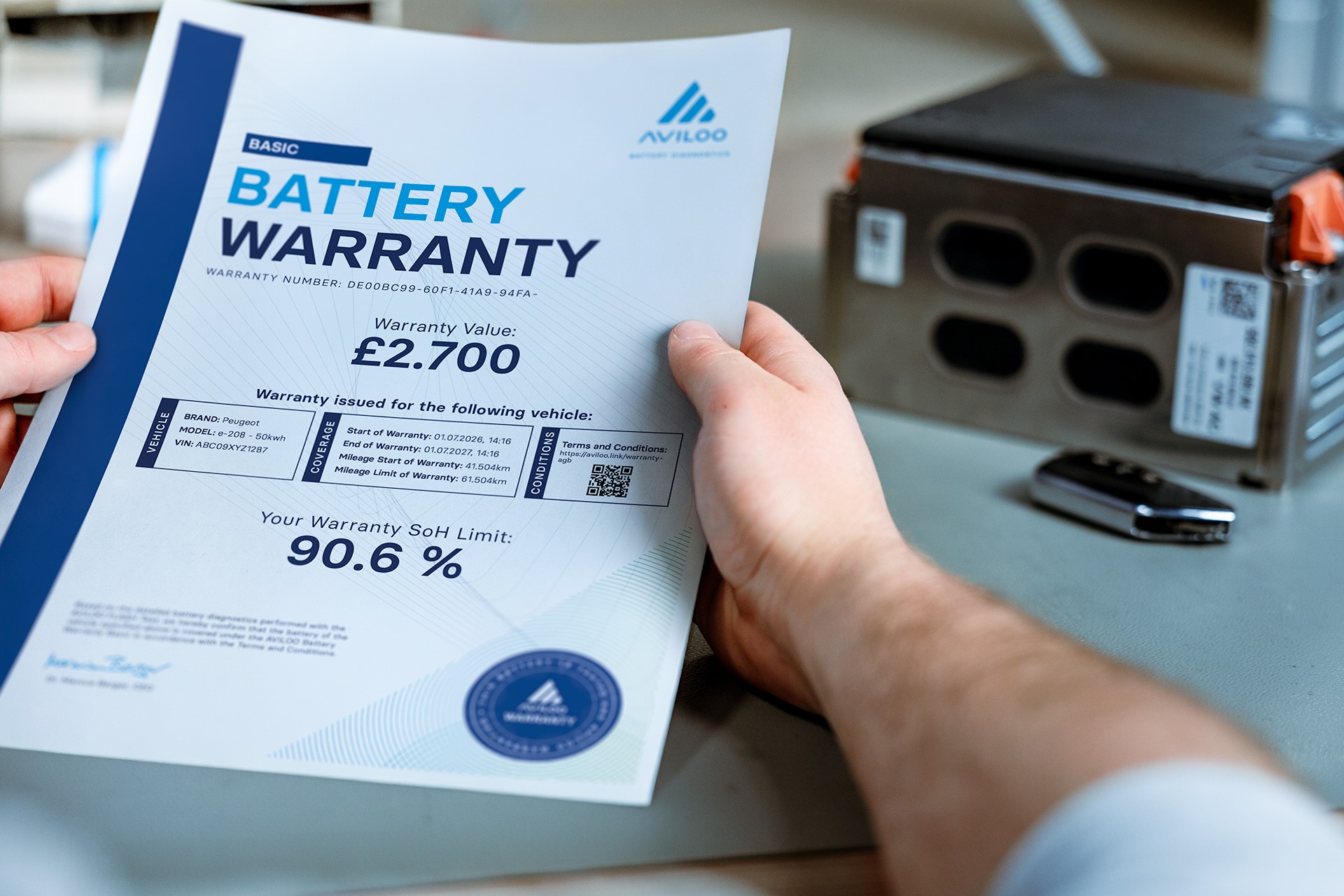
Every eligible EV you certify with AVILOO now comes with a £2,700 warranty from AVILOO themselves, reinsured by Swiss Re, at no extra cost. It covers 12 months or 20,000 km, whichever comes first. If the certified battery's State of Health falls below the predicted threshold within that period, AVILOO pays the vehicle owner directly. Covers cars bought on finance too.
V12 Sports & Classics, one of the UK's leading independent dealerships, integrated AVILOO into their used EV sales process to answer the buyer's first question with documented, third-party evidence. The same evidence standard the franchise groups use, deployed by an independent.
V12 spotted the same shift Tony's network is spotting now: used EV buyers want certainty before they commit. So they built independent battery certification into every EV sale.
The result, listings that answer the buyer's first question before they have to ask, a measurable uplift in buyer confidence, and a way to stand out in the most competitive segment of the used market without dropping price to compete.
The takeaway for independent dealers: the certificate does the heavy lifting on trust, the battery question comes off the table, and EVs move faster off the forecourt, the same outcome the AVILOO international remarketing study reports across hundreds of dealerships.
AVILOO is the Austrian-engineered battery diagnostic platform distributed in the UK by MotorCheck. A plug-in OBD device captures cell-level data directly from the vehicle and AVILOO's cloud issues a VIN-tied, third-party certificate, the kind of independent, methodology-backed evidence the Ombudsman looks for.
OBD-connected unit plugs into the vehicle. No workshop, no ramp, no technician training required.
Three minutes to capture cell-level data directly from the battery, far beyond what the car's own BMS reports.
AVILOO's cloud issues a third-party, VIN-tied certificate with independently-verified state of health.
Retain the certificate against the vehicle's record. If a complaint lands months later, the evidence is already on file.
Watch how a dealer or technician runs the full battery test on any EV, from plugging in the OBD device to issuing the independent certificate.
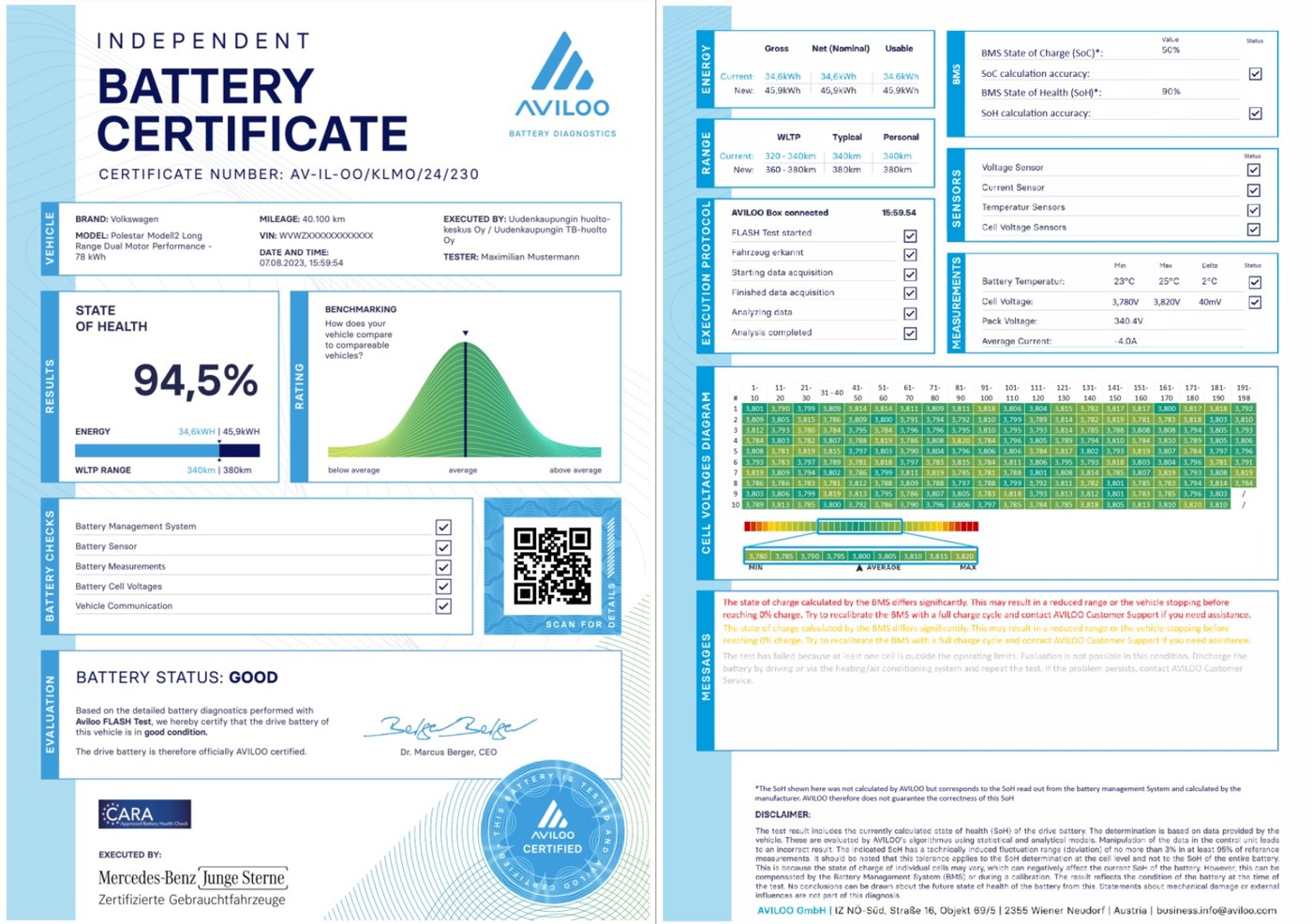
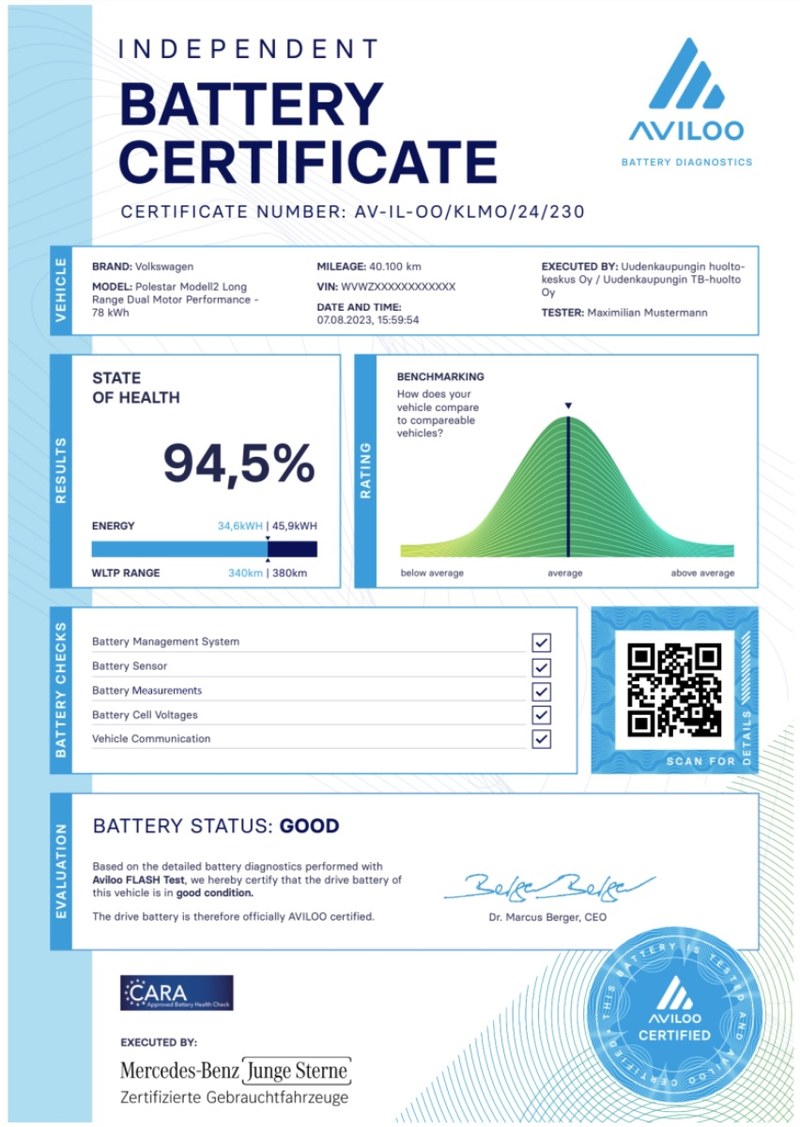
The AVILOO certificate documents the battery's exact state of health on the date the test was run, the precise evidence the Ombudsman looks for when asking whether a fault was "present or emerging at the point of supply". A clean certificate at sale = a documented "no" to that question, retained for the life of the agreement.
An AVILOO-documented case: a Nissan Leaf with 11 of 12 health bars on the dashboard, implying 90–93% state of health. The owner had paid €50,000 four years earlier on the strength of that figure. An AVILOO Premium Test on the same car returned 42%. The car was eventually replaced under warranty, but only after independent evidence demonstrated what the BMS was hiding.
The same test identified a separate safety issue: under sustained full-throttle acceleration, cell voltages dropped to 1.4V (well outside cell-manufacturer specification, with attendant fire risk) and the car would shut down without warning. No fault code was ever logged by the vehicle.
The case for the cert isn't just the upside. It's the downside the dealers without it are now staring at, and the FOS data is unambiguous on what happens next.
MotorCheck analysed every decision ever published by the Financial Ombudsman Service, 375,328 in total, and identified 271 verified EV battery complaints. In 49 of those cases, the Ombudsman explicitly weighed battery evidence as part of their reasoning. Collectively, more than £1 million in consumer claims was adjudicated. The outcome was binary.
A documented battery health check at the point of sale was enough. In every one of 29 cases where the dealer could produce independent evidence of battery condition, the complaint was dismissed.
No documentation. No defence. The Ombudsman's reasoning is consistent: "in the absence of any further evidence…", "no evidence has been provided…", "the vehicle health check recorded no issues."
Source: MotorCheck Research 2026, "The Evidence Gap". Independent analysis of 375,328 Financial Ombudsman Service decisions.
Today's Ombudsman decisions concern EVs sold three to four years ago, when the UK EV parc was a fraction of its current size. Between 2026 and 2030, more than half a million EVs exit manufacturer warranty. The complaint volume we're seeing today is the leading edge, not the limit.
From 1 case in 2013 to 96 in 2025. The last two years have seen 71% and 93% year-on-year growth.
Today's FOS complaints stem from just 80,000 EVs exiting warranty. By 2030, that figure exceeds half a million.
Projected annual industry exposure by 2029. At current growth rates, with over half a million EVs exiting manufacturer warranty between 2026 and 2030, industry-wide EV complaint exposure could exceed £10 million annually, roughly six times the 2025 level. The mass-market wave has not yet reached the FOS.
The regulatory environment is moving unambiguously towards mandatory, independent, documented battery condition at point of sale. Selling a used EV without knowing the state of its battery is increasingly difficult to reconcile with FCA Consumer Duty obligations to identify and mitigate foreseeable harms.
Firms must proactively identify and mitigate foreseeable harms. An undocumented used EV battery is, on the FOS evidence, a foreseeable harm. Recent Ombudsman decisions increasingly cite Consumer Duty directly.
Goods supplied under finance must be of satisfactory quality at point of supply. Within the first six months, faults are presumed to have been present, and the burden shifts to the dealer to prove otherwise.
Mandatory documentation of state of health, charge cycles, capacity, and maintenance history for every EV battery above 2kWh. UK consultation on mirrored requirements is already under way.
Mr R complained about a 20% range reduction in winter on his used Mercedes EV. He'd signed a £54,956 finance agreement and wanted the full sum refunded. The dealer won because, and only because, they had a documented EV battery health check on file from the day of sale.
"The vehicle health check dated March 2025 recorded no issues with the battery or components in the EV Check section of the form. And in the absence of any further evidence from Mr R that showed there was a fault with the battery or its charging components that was present or developing at the point of supply, [the Ombudsman] was unable to conclude that the car was not of satisfactory quality."
One prevented rejection pays for hundreds of battery checks. Add the faster sales, the price premium, and the £2,700 warranty on eligible EVs, and the cost-of-action box gets harder to argue with by the line.
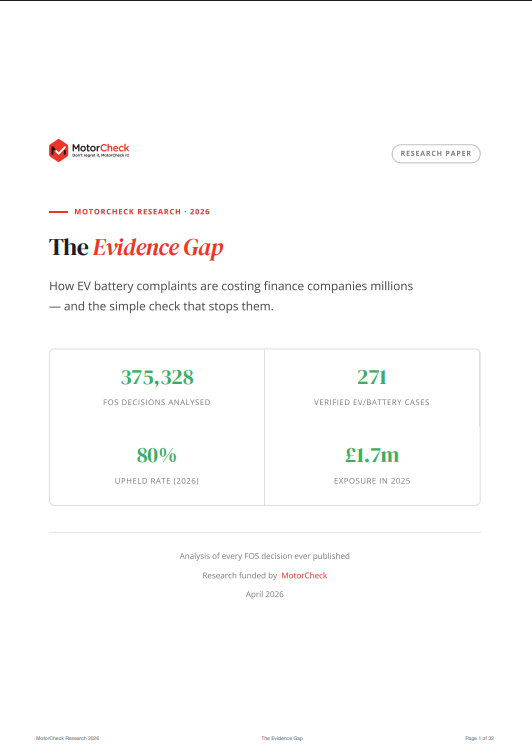
The Evidence Gap is MotorCheck's independent analysis of every decision ever published by the Financial Ombudsman Service, the largest study of EV finance complaints conducted in the UK. Every stat on this page is sourced from it.
The dealers I coach who are getting it right with EVs all do the same thing: they answer the buyer's first question before it's even asked. AVILOO gives independent dealers the same evidence standard the franchise networks use, and the £2,700 warranty on eligible EVs is a genuine after-sale promise you can hand the customer. Faster sales, better margins, real compliance cover. No sharks. No pressure. Just evidence.
Every dot on the map is an active AVILOO unit in the UK today, already running tests, already issuing certificates, already protecting dealer finance books against the next FOS complaint. From the UK's largest automotive traders to independent dealerships, businesses are embedding independent battery evidence into their used EV process.
…and hundreds of UK car dealers building trust with every EV sale.
Reinsured by Swiss Re, one of the world's largest reinsurers.
Every eligible EV you certify with AVILOO now carries an independent warranty that travels with the vehicle. It's the first and only EV battery test in the market backed this way, with genuine financial substance behind it, not just a company's own promise. It gives your customers real reassurance, and you a stronger story at the point of sale, included at no extra cost.
It's a separate, financially-backed warranty issued alongside the independent AVILOO battery certificate and reinsured by Swiss Re. The certificate records the battery's health on the day of the test; the warranty adds protection if that battery degrades faster than forecast during the cover period.
No. They are two separate documents. The certificate is independent evidence of the battery's condition at the point of sale. The warranty is an added layer on top that travels with the vehicle, protecting against abnormally fast degradation.
Twelve months or 20,000 km from the date of the AVILOO test, whichever comes first. The period is fixed from the test date and printed on the warranty certificate.
Eligible battery-electric vehicles (BEVs) that pass AVILOO's automatic eligibility check at the time of the test. Plug-in hybrids still receive a full AVILOO certificate, but the warranty itself is for BEVs. The vehicle's model also needs to be on AVILOO's coverage list and pass the Flash Test cleanly, and batteries that are already heavily degraded may not qualify.
Nothing extra. It's included with every eligible AVILOO Flash Test at no additional cost, with no separate product to price up.
Yes. The warranty covers eligible vehicles whether the customer buys outright or on PCP or hire purchase, and it travels with the car if it's sold on during the cover period.
A fixed £2,700, paid to the owner if the battery falls below its certified threshold. It's a set cash sum, not a contribution towards a repair, and the validation test is refunded on a confirmed claim.
Within the cover period the owner has a second AVILOO Flash Test and submits the claim directly to AVILOO. If it confirms the battery has dropped below its threshold, AVILOO pays the £2,700 and refunds that test. The claim is handled by AVILOO, not the dealer.
It's issued digitally through AVILOO Connect alongside the test result, not posted or emailed as a separate PDF.
Tell us a little about your business and we'll be in touch within 24 hours to tailor a package to your volume.
We'll contact you within 24 hours to discuss your requirements.